
On Magnanimity
Is the virtue of being great-souled, great-minded, or great-hearted...elitist?

What is Magnanimity?
What is the virtue that enables outstanding leaders to handle the stress, challenges, and priority-setting required to succeed in high-stakes endeavors? What is the virtue of greatness that enables high-minded and high-capacity men and women to perform great deeds? For St. Thomas, following Aristotle, it’s magnanimity.
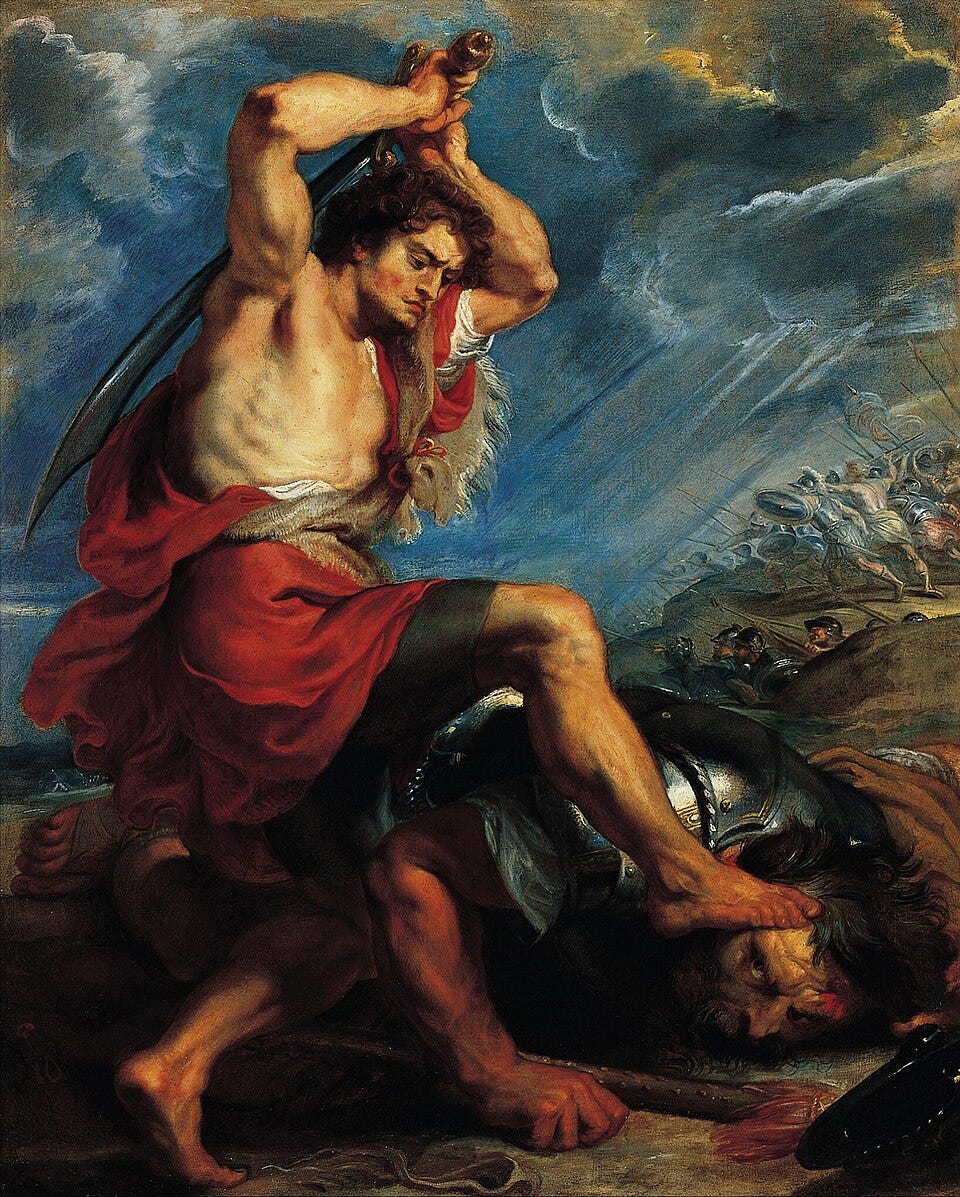
Imagine a young David willing to face a giant that everyone in the entire army of Israel was afraid to face. Imagine the pressure to perform in front of thousands of onlookers to determine the fate of Israel. David’s defeat meant the enslavement of his people, not to mention his own death. But if he won, his victory meant their freedom and the defeat of their enemies. This young man rose to the occasion and, through his trust in God, slew Goliath and routed the Philistines. This was not simply an act of fortitude一although it certainly was一but also magnanimity.
Magnanimity is the virtue to be great-souled, great-minded, or great-hearted. It, along with magnificence, are the virtues of greatness. They take what is good in a virtue and make it great.

The Contribution of Magnanimity
The special contribution of magnanimity as a virtue is to enhance other virtues and make them function at their highest levels despite the significant challenges of operating at such levels. Let’s return to the story of David and Goliath. Magnanimity enhanced David’s fortitude and enabled him to act bravely一that is, with proper fear, hope, and daring一in a spectacular way. Many would have folded under the intense fear, but magnanimity steadies a virtue like fortitude when it’s at its breaking point. Magnanimity enables each virtue to operate at the height of its powers, which is why Aristotle calls it the crown of the virtues. Magnanimity crowns or ennobles the other virtues by bringing them to their utmost excellence. The way it does so is by enabling the person to remain high-minded and noble-hearted amidst the intense pressures of great undertakings.
Objections to Magnanimity
Despite the greatness of magnanimity, it is sometimes thought to be not so great. To see why, consider what Thomas Aquinas writes,
“Magnanimity by its very name denotes stretching forth of the mind to great things….. Now a man is said to be magnanimous in respect of things that are great absolutely and simply, just as a man is said to be brave in respect of things that are difficult simply. It follows therefore that magnanimity is about honors.”
Reading this might raise a few questioning eyebrows. Is magnanimity elitist if it regards only the absolutely greatest of acts? Is it contrary to humility if it’s about honors? If this comes to mind, you are not alone. The goodness of the classical ideal of magnanimity has long been a matter of dispute among Christians from early times to today.
The charge of elitism stems from magnanimity’s requirement of fully developed virtue and significant natural and cultivated talent and capacity. If it exclusively concerns what is absolutely and simply great, then only those with very high capacities are eligible. Many can write a good book. Very few could have written the Summa Theologiae. Many can give a good speech to a crowd. Very few could have given The Gettysburg Address. These rare heights seem to limit magnanimity to the elite few. Not to mention, Aquinas also suggests that external resources are also conducive to the exercise of this virtue. So, it seems like magnanimity is for the talented and well-off. St. Thomas even says, “Wherefore the act of magnanimity is not becoming to every virtuous man, but only to great men.” Isn’t that elitist!
However, St. Thomas knows that with God, all things are possible. With grace, magnanimity becomes the potential inheritance of anyone. So, for the magnanimity that is infused in each person in a state of grace, any person can potentially exercise it. Aquinas writes, “Magnanimity makes a man deem himself worthy of great things in consideration of the gifts he holds from God.”
God’s gifts enable people to do objectively great things that transcend their natural capacities, because it is God’s grace that is at work within them. That is to say, it is God who is accomplishing great works, and His people are His chosen medium. With the help of His grace, the saints endured tremendous suffering and torture, founded religious orders, established global charities, and more because God was with them and blessed the work of their hands.
The second charge against magnanimity is that the magnanimous person is proud or vain because he or she is aiming at honor. So, magnanimity seems contrary to humility. But St. Thomas doesn’t draw this conclusion. There is a careful distinction in his words that is easy to miss: magnanimity involves objectively great things in any area that are worthy of honor.
Recall David’s defeat of Goliath. The greatness of his deed won him renown, and the daughters of Jerusalem praised him for slaying more of their enemies than King Saul (which caused envy in the vain heart of Saul). However, David did not slay Goliath to gain honor; the deed was worthy of it. Being worthy of true honor is a sign of the greatness of the act. Furthermore, magnanimous persons know it is good to receive honor because such actions are exemplary and hopefully encourage greater desire for virtue in their community.
It’s St. Thomas’s vision of humility that saves magnanimity from going off the rails. For humility restrains the desire for greatness and honor lest a person aim for what is beyond him or her. Humility protects magnanimity from becoming pridefully inflated into megalomania.
Finally, God gives grace to the humble, and, with humility, a person is able to receive from God the power to be truly great despite lacking elite natural capacity. For God’s grace is enough for greatness (cf. 2 Cor. 12:9).
In sum, magnanimity makes great use of good virtues. It crowns the life of virtue and enables a heroic life of virtue. Fueled by grace, it’s a virtue open to all.
About the Author: Professor Scott Cleveland received his PhD in philosophy (Baylor University) and is Associate Professor of Philosophy and Catholic Studies at the University of Mary (Bismarck, ND). His research interests are in ethics, moral psychology, and philosophy of religion. He is especially interested in the study of virtues and emotions, the relation between the two, and the role of each in the moral and intellectual life. His thought is deeply influenced by Aristotle and Aquinas, and his work has appeared in journals such as American Catholic Philosophical Quarterly, Res Philosophica, Religious Studies, Religions, and the Proceedings of the American Catholic Philosophical Association. He is also a frequent speaker at Thomistic Institute campus events. He is the co-editor with Adam Pelser of Faith and Virtue Formation: Essays in Aid of Becoming Good with Oxford University Press.
 | A guest post by
|