
Aquinas on Endurance
Patience vs. perseverance, and other distinctions

Picture yourself on a peaceful morning hike with your kids. The sun is dappling through the trees, birds are chirping, and then – because the universe is not without a sense of the absurd – you round a turn and find yourself face-to-face with a bear. Bet you didn’t see that coming!


You and everyone you know has dangerous, difficult, and onerous things they face in their lives. Some of these things are external to us: a belligerent family member, a difficult degree program, a snarling dog, etc. Others of these are internal: the frustration of dealing with the same daily hassles over and over, sorrow over an uncertain future, your temper, etc. In any such case, our first impulse is to avoid the worst of it. We might do this by dodging the situations entirely, or by preparing to face them well, or by making preemptive strikes.
Sometimes you plan the hike to avoid bear territory; sometimes you bring bear spray; sometimes you take the initiative when stumbling upon the bear to blow your airhorn in the hopes of scaring it away. And sometimes, after dodging and preparing, when all else fails and you are out on a stroll with your kids…sometimes you just have to wrestle a bear. (“Well, I could just outrun my kids,” is true, but ghastly. Living with that would be unbearable.)
Distinctions among Types of Endurance
In this post, I discuss the main types of difficulties we must endure, as distinguished by St. Thomas Aquinas. I begin, as he began, by separating internal from external objects of endurance.
Among the internal things we must endure, there’s the sorrow we suffer and the anger we experience. Sometimes the problem isn’t really something outside of me. It is my own foul mood, or my own ill-temper. Maybe I’m hangry and taking it out on my family. Or I’m being overly dramatic about something that is, objectively speaking (as I’ll sheepishly admit later), not that big of a deal.
Other times, the thing to be endured is external. There’s an obstacle out there, which is difficult to deal with, whether or not it causes us anger or sorrow. In such cases, I might say, “That was hard, but it didn’t remove my cool.”
Among the external things to endure, we can focus on obstacles, distinguishing between those obstacles intrinsic to the activity I’m doing and those extrinsically added on to the activity. Sometimes you endure external things that are intrinsic to your goal – like the hardships of learning complicated math or the soreness of your muscles when training for a marathon. Sometimes you endure external things that are extrinsic to your goal– like the additional hardship Ruby Bridges faced in her education from the protesters chanting terrible things about her outside the building. That’s not something intrinsic to the difficulties of learning long division. Or, in addition to the muscle soreness typical of training for a marathon, sometimes you face the additional hardship of running in the sleet.
Aquinas gives different names to the virtues that endurance requires to such external things. Perseverance is enduring the inherent difficulty of the task itself. Constancy is enduring added difficulties from the surrounding circumstances.
Just as we have terms to distinguish the virtues of endurance, we also have terms for the vices of endurance. For instance, someone who lets his suffering and sorrow get the best of him is impatient; someone who lets his anger get the best of him is wrathful. Someone who lets the intrinsic obstacles beat him prematurely is irresolute – he quits too soon when things aren’t going his way. Someone who lets the extrinsic obstacles beat him prematurely is inconstant – he lacks the constancy needed to stay the course despite the hurdles. And, of course, one could fail the other way, too. One who is deficiently moved by sorrow is apathetic – we’d say he’s unfeeling. Someone insufficiently moved by anger is indifferent. Someone who keeps slamming headfirst into the obstacles in his path, whether internal or external, might be called intransigent.
The Importance of the Distinctions
Aquinas was nothing if not enamored with distinctions. Sometimes people charge him with making distinctions just for the sake of distinguishing. (Charles Dickens was accused of being verbose because he was paid by the word–you might wonder if the medievals were paid by the distinction.)
Even still, the distinctions Aquinas drew are important for the good life. For if the various virtues of endurance come apart, then the moral liabilities we have, and the practices of cultivation we should employ to grow in virtue, come apart, too. And, the virtues do come apart, as I go on to argue.
When looking at Aquinas’s distinctions here, you might wonder: what’s the important difference between enduring the external thing and enduring the internal emotions caused by the external thing? It turns out there’s a pretty clear difference, and you’ve experienced it yourself.
Sometimes you face a situation that is extremely difficult and trying. But you are in the zone; you rise to the occasion; you succeed. Maybe you are playing the best team. Or maybe you are bearing a huge burden at work. But you do it well, and you can honestly say to yourself afterwards,
“Man alive that was hard! But I endured and succeeded without feeling any negative emotions.”
In that case, we’d likely praise you for your perseverance, not your patience. The main thing you were fighting was external to you, an obstacle out there that you overcame. Your emotions weren’t an additional opponent, double-teaming you.
Sometimes, on the other hand, you face a situation that is, objectively speaking, not a big deal. But your emotions get the better of you. You snap at a friend, luxuriate in your misery, and dampen the communal atmosphere with your pouting. In such a case, you might later confess,
“Look, I reacted really poorly back there; it wasn’t a big deal, but I let it get me all twisted up. I’m sorry.”
In such a case, you’ve had big feelings at non-big things. The external things were not the culprit; your internal states were. You’ve let sadness or irritation get the best of you.
Not only do the virtues of enduring internal things come apart from the virtues of enduring external things, we also know that the two virtues of enduring the external—constancy and perseverance—are distinct. For we know people who, for instance, are really good at committing to and completing tasks, but are inflexible at doing so when external situations make the completion difficult. Maybe he’s great at meeting his mile goals when he can run early in the morning, but if he has to take a kid to the doctor one morning, he has difficulty pivoting to running in the afternoon. The difficulties intrinsic to running aren’t causing him to stumble. Rather, it is the obstacles that come from being a father with familial obligations, difficulties extrinsic to running, that prove insuperable.

What We Want in Ourselves and Those We Love
The problem with all these things to be endured is that we are so often tempted to give in to them, even when the better path is clear. It takes prudence to determine whether we should face or flee the difficulty. Sometimes flight is the right choice. But making that right choice in many cases is hindered by our urges to flee, which tempt us to flee more than we ought. How many times have we let the difficulties get the best of us, choosing to sidestep or lie down, rather than stand and endure what we know we ought to?
None of us would want our loved ones – our siblings, our children – to be plagued by these moral liabilities. The intransigent, for instance, often have the flaws of a workaholic, prioritizing success in this one arena over the other goods that ought to take precedence. Or as another example, the impatient or wrathful family member can suck the good spirit and joy out of a family meal. No one wants this for those they love. No doubt you’ve been in a situation where someone said something like the following:
“Man, Mom was in such a great mood earlier. She was humming while she cooked, so happy that she’d have us all home for a meal together. And then you came in snapping at everyone, grumbling about this or that. A real buzz kill. You made her cry.”
No one wants that! Better if we could control ourselves, such that, even if the day were lousy, we wouldn’t take it out on those we love. We will all deal with obstacles, anger, and suffering. It is a good feature in a person to be able to deal with such things without ruining the day for everyone else. It is a self-mastery.
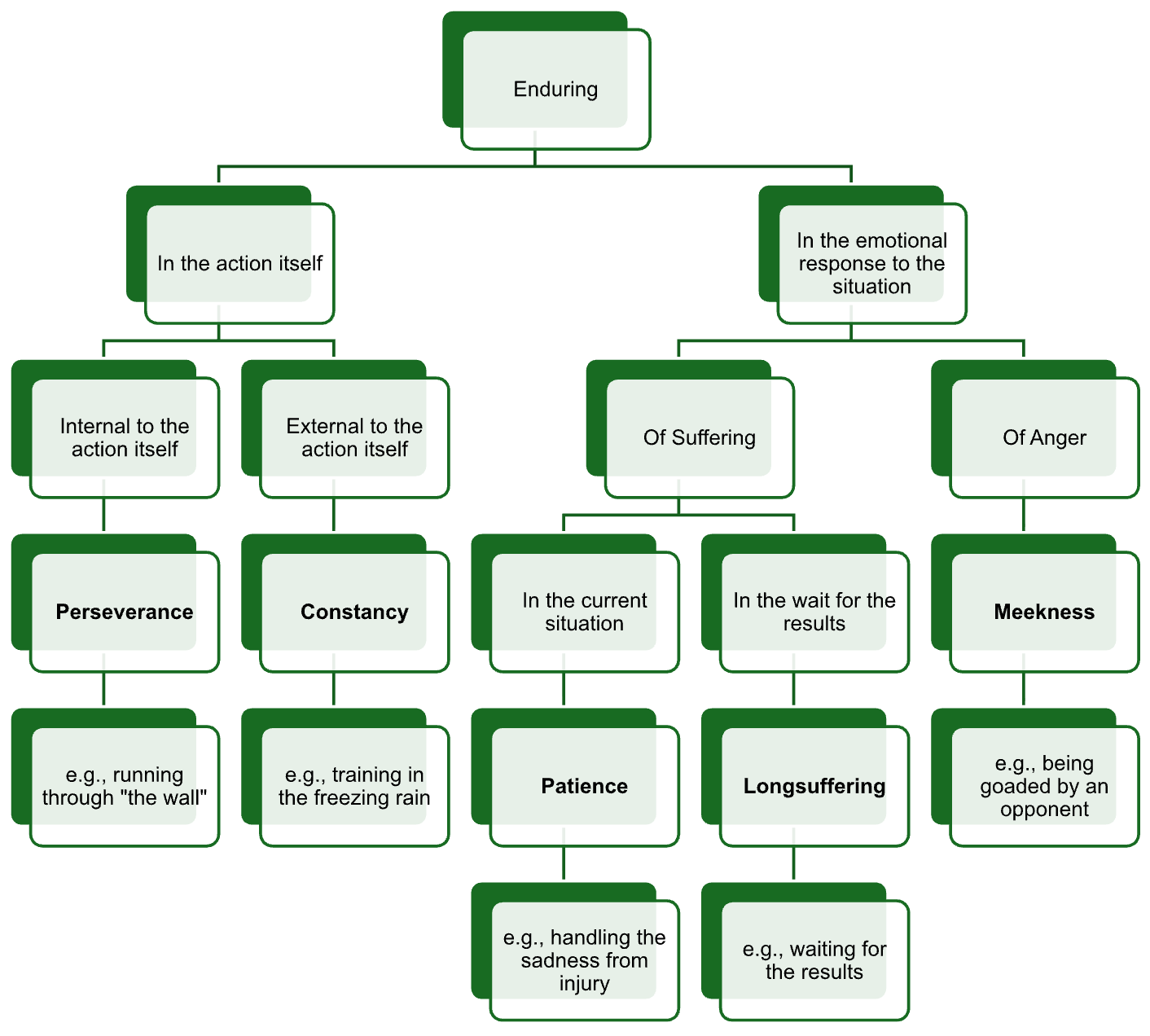
The figure above spells out the way that St. Thomas Aquinas differentiates types of endurance. Aquinas places meekness under temperance at some points, not fortitude, for technical reasons. Even so, he sees it as an instance of excellent endurance of anger.
Life will always have its bears, both the literal ones that might interrupt our hikes, and the metaphorical ones that interrupt our peace. We can’t always determine what difficulties we will face, but we can determine the character we bring to the confrontation. The virtues of endurance are the bear spray, hiking boots, and trail maps that help us navigate life’s wilderness with grace.
 | A guest post by
|